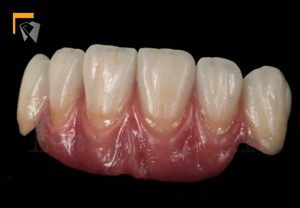
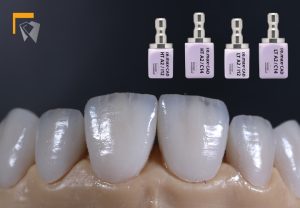
There are few factors that play a vital role in the success of the E.max crown restorations. Here we will talk about the tooth preparation requirements and trimming suggestions of E.max restorations.
Successful results can only be achieved with IPS e.max if the preparation guidelines below and the minimum layer thicknesses are strictly observed.
As a rule of thumb E.max crown preparations should have an overall even anatomical tooth shape reduction at the advised limit, shoulder/chamfer margin and no sharp angles or corners to maximise the chances of a successful result. For CAD/CAM fabricated restorations, the incisal edge of the preparation should be at least 1.0 mm (milling tool geometry) in order to permit optimum milling of the incisal.
There are other factors that should be considered when making decisions on the suitability of E.max crowns. For example E.max should be avoided on patients with heavy occlusion or if a patient has bruxism or clenches their teeth regularly. In this situation a zirconia crown would be a better choice.
FULL COVERAGE POSTERIOR CROWN PREPARATION
Posterior full coverage crowns will require:
- 1mm shoulder with rounded inner edge or 20-30 degree chamfer margin preparation
- Even anatomical shape reduction
- Occlusal reduction of 1.5-2mm
- Buccal, lingual and interproximal reduction of 1.5mm
- Rounded internal line edges
- Taper between 4 and 8 degrees
- No sharp angles or edges
FULL COVERAGE ANTERIOR CROWN PREPARATION
- Even anatomical shape reduction
- 1mm circular shoulder with rounded inner edges or a chamfer at an angle
of approximately 10 to 30 degrees
- 1.5mm reduction to the incisal third of the crown
- 1.2mm reduction to the vestibular and/or oral area
- For conventional and/or self-adhesive cementation, make sure that the preparation demonstrates retentive surfaces and a sufficient preparation height of at least 4.0 mm
3 UNIT BRIDGES
The preparation of the abutment teeth is the same as for anterior and posterior crowns.
Given the different masticatory forces, the maximum acceptable pontic width is different in the anterior and premolar region.
– In the anterior region (up to the canine), the pontic width should not exceed 11.0 mm
– In the premolar region (canine up to the second premolar), the pontic width should not exceed 9.0 mm
– The pontic width is determined on the unprepared tooth
DIAGRAM FROM 3 unit bridge diagram
PARTIAL CROWN
– Make sure that the preparation margins are not located in the area of static or dynamic
antagonist contacts
– Provide at least 1.5 mm of space in the cusp areas
– 1.0mm circular shoulder with rounded inner edges or a chamfer at an angle of
approximately 20 to 30 degrees
INLAYS/ONLAYS
- Make sure that the preparation margins are not located in the area of static or dynamic
antagonist contacts
- At least 1.0 mm preparation depth and 1.0mm width of the isthmus in the fissure area
- Prepare the proximal box with slightly diverging walls and observe an angle of 100 to 120 degrees between the proximal cavity walls and the prospective proximal inlay surfaces
- Avoid marginal ridge contacts on the inlay in case of pronounced convex cavity walls without adequate support by the proximal shoulder
- Round out internal edges in order to prevent stress concentration within the ceramic
Material
- Do not prepare slice-cuts or feather edges
- Provide at least 1.0 mm of space in the cusp areas for onlays
DIAGRAM FROM Onlay-Inlay prep diagram
OCCLUSAL VENEERS
− Even anatomical shape reduction
– 1.0mm circular shoulder with rounded inner edges or a chamfer at an angle of
approximately 10 to 30 degrees
– Reduce the occlusal part by at least 1.0 mm
VENEER
– If possible, locate the preparation in the enamel
– Do not locate the incisal preparation margins in the area of the abrasion surfaces or
dynamic occlusal surfaces
– If sufficient space is available, you can even leave out the preparation entirely (depending on the fabrication method)
– Reduce the cervical and/or labial area by 0.6 mm, and the incisal edge by at least 0.7 mm.
At HowLite Dental Laboratory, our technicians will be there to guide you on a case-by-case basis to ensure the best possible results.